6 Best Automatic Trash Cans (October 2026)
The best automatic trash cans include the Ninestars 21 Gal XL Sensor Can for large kitchens, the iTouchless 24 Gal Sensor Can for high-volume households, and the EKO Mirage X 21 Gal Sensor Can for long meal prep.
On this page (10 sections)
- How we chose the best automatic trash cans
- Which automatic trash can fits your kitchen?
- What capacity should an automatic trash can have?
- How much room does a sensor can need?
- Which power setup should you check before buying?
- How should you set up an automatic trash can?
- Do odor features change which can you should choose?
- How do you keep the lid and sensor working properly?
- Which mistakes make an automatic trash can less useful?
- Which best automatic trash can should you choose?
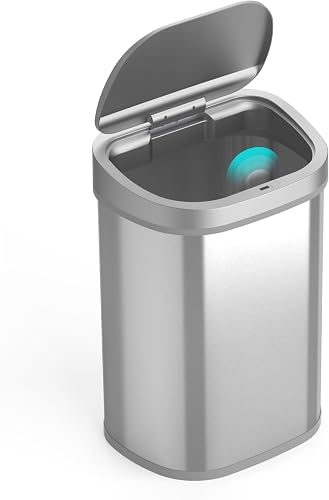
The Ninestars 21 Gal XL Sensor Can is the best automatic trash can for a large kitchen that fills a smaller bin too quickly. For moderate daily waste, the Ninestars 13 Gal Oval is a better fit than buying extra capacity you won't use.
The other picks solve different problems: iTouchless adds a carbon filter and optional plug-in power, while EKO keeps its lid open during longer prep tasks. Choose around your waste routine and available space before comparing extra features.
For a broader look at hands-free models, see our best touchless trash cans and best motion sensor trash cans. Here, the focus is choosing a powered lid you can place, fill and maintain comfortably.
Our picks at a glance
-
1
-
2

-
3

- 4
 Check it
Ninestars 13 Gal Oval Sensor Can
Best for smaller kitchen spaces - 5
 Check it
Ninestars 13 + 3 Gal Combo Set
Best for coordinating two rooms - 6
 Check it
Ninestars 18.5 Gal Semi-Round Can
Best for sorting kitchen waste
How we chose the best automatic trash cans
The best automatic trash cans combine useful capacity, accessible placement and a lid that fits your routine. We compared dimensions, power requirements, bag handling and features that serve a clear household need.
A large bin earns its space when packaging fills the bag quickly. A smaller one can be the better choice when food scraps require frequent emptying anyway.
We also separated features that solve different problems. A stay-open mode helps during repeated disposal, a filter addresses odors, and a second compartment helps sort waste.
Our scores reflect those features and how well each can suits its intended buyer. The highest-scoring pick leads this group, but a smaller kitchen or a recycling routine can make a lower-ranked model the better choice.
| Product | Best for | Capacity | Shape | Power | Our score |
|---|---|---|---|---|---|
| Ninestars 21 Gal XL Sensor Can | large kitchens | 21 gallons / 80 liters | Rectangular | 3 D batteries, not included | 8.1 |
| iTouchless 24 Gal Sensor Can | high-volume households | 24 gallons / 91 liters | Oval | 4 D batteries or optional AC adapter | 7.9 |
| EKO Mirage X 21 Gal Sensor Can | long meal prep | 80 liters / 21.1 gallons | Rectangular | 7.9 | |
| Ninestars 13 Gal Oval Sensor Can | smaller kitchen spaces | 13.2 gallons / 50 liters | Oval | 3 C batteries, not included | 7.8 |
| Ninestars 13 + 3 Gal Combo Set | coordinating two rooms | 13 gallons and 3 gallons | Oval | 3 C batteries for kitchen can, 2 C batteries for bathroom can, not included | 7.6 |
| Ninestars 18.5 Gal Semi-Round Can | sorting kitchen waste | 18.5 gallons nominal total; about 9.25 gallons per compartment | D-shaped | 4 D batteries, not included | 7.4 |
Which automatic trash can fits your kitchen?
Choose the XL Ninestars for large mixed-waste loads, iTouchless for a tall high-capacity bin, or EKO for repeated disposal during meal prep. The smaller Ninestars models suit moderate waste, two-room use or separate trash and recycling.
Ninestars 21 Gal XL Sensor Can: our top automatic trash can
Ninestars 21 Gal XL Sensor Can: Best for large kitchens
- 21 gallons / 80 liters
- Rectangular stainless steel body
- Uses 3 D batteries
- Removable lid
Choose this large rectangular can when family meals and frequent cleanup fill a smaller bin too quickly. Its removable lid gives you access for bag changes.
Pros
- Room for high daily waste volume
- Fingerprint-resistant stainless steel
- Includes a liner ring
Cons
- Broad footprint needs floor space
- Batteries are not included
The Ninestars 21 Gal XL Sensor Can suits a household that regularly fills smaller bags with meal packaging and everyday kitchen waste. Its main advantage is room to collect a larger load without crowding waste against the lid.
The body measures 18.78 in long, 14.45 in wide and 27.4 in high. Mark that footprint on the floor before ordering, then check that nearby cabinet doors can swing past it.
This is a sensible choice beside a broad cabinet run or in an open kitchen corner. Skip it if the bin would narrow your main walkway or if you usually remove food waste while the bag is still mostly empty.
The removable lid and included liner ring give you access to fit a fresh bag. Leave enough room to lift the lid away and pull a filled bag upward without moving the can each time.
Ninestars claims 6–9 months of battery use, though your opening frequency will affect replacement needs. Use our kitchen trash can sizes guide if you're unsure how much larger this is than your current bin.
iTouchless 24 Gal Sensor Can
iTouchless 24 Gal Sensor Can: Best for high-volume households
- 24 gallons / 91 liters
- Oval footprint
- Includes carbon odor filter
- Battery or optional adapter power
The largest bin here suits homes that produce bulky waste and have room above a tall can. Its included carbon filter and optional plug-in power add useful choices.
Pros
- Largest capacity in this group
- Includes a carbon odor filter
- Accepts standard 24- to 30-gallon bags
Cons
- Optional adapter sold separately
- Tall body needs careful overhead clearance
Choose the iTouchless 24 Gal Sensor Can when bulky waste fills your bin quickly and you want an included carbon odor filter. Its tall shape offers more capacity here without having the broadest base.
The body measures 17.4 in long, 12.3 in wide and 33 in high. That height makes it better suited to an open location beside an island than a space beneath a low counter.
It accepts standard 24- to 30-gallon bags, with a retainer ring to hold the bag edge. Check bag depth as well as capacity, since a bag that hangs short can pull loose when waste lands inside.
Optional adapter power makes sense for a fixed spot near a suitable outlet. Battery power gives you more freedom to move the bin, while the adapter is a separate item to account for.
Skip this model if lifting a tall, heavily filled bag would be awkward. Emptying before the bag becomes too heavy is more useful than treating maximum capacity as a target.
The filter is an extra odor tool, not a reason to leave scraps longer. Our guide to keeping a kitchen trash can from smelling covers the routine that matters most.
EKO Mirage X 21 Gal Sensor Can
EKO Mirage X 21 Gal Sensor Can: Best for long meal prep
- 80 liters / 21.1 gallons
- 20-minute press-to-open mode
- Anti-fingerprint stainless steel
- Quiet-close lid
Choose the Mirage X when you want an open bin during a run of peeling, trimming and cleanup. Its narrower rectangular body is worth measuring against your available floor space.
Pros
- Stay-open mode for repeated disposal
- Anti-fingerprint finish
- Large capacity
Cons
- Open lid needs overhead clearance
- Stay-open use leaves waste exposed
The EKO Mirage X 21 Gal Sensor Can is the strongest fit for cooks who make several trips to the bin during one task. Its press-to-open mode holds the lid open for 20 minutes, so repeated disposal doesn't require another wave each time.
That feature is useful when peeling vegetables, trimming ingredients or clearing several plates. Keep the opening near your prep area so you can transfer scraps without carrying them across the kitchen.
Its rectangular body measures 18.5 in long, 11 in wide and 27.1 in high. Compared with the XL top pick, its narrower body may suit a shallower floor space, though you still need to measure the full placement.
Choose this model for how you cook, rather than for a feature you'll rarely use. Skip it if you mostly discard one item at a time or need the lid kept closed around curious pets.
EKO describes the stainless steel finish as anti-fingerprint. Wipe food splashes promptly anyway, especially near the sensor and lid seam, where surface appearance matters less than keeping the opening clear.
Ninestars 13 Gal Oval Sensor Can
Ninestars 13 Gal Oval Sensor Can: Best for smaller kitchen spaces
- 13.2 gallons / 50 liters
- Wide oval opening
- Odor-sealing lid
- Uses 3 C batteries
This oval can suits moderate kitchen waste and cabinet-side placement. Its wide opening helps with bulky packaging without moving up to an extra-large bin.
Pros
- Smaller footprint than the XL top pick
- Soft-closing odor-sealing lid
- Removable liner ring hides bag edges
Cons
- Less room for bulky waste loads
- Batteries are not included
The Ninestars 13 Gal Oval Sensor Can is the better starting point for moderate waste and a smaller kitchen. It avoids the extra floor space and larger bag loads that come with the XL options.
Its body measures 16.5 in long, 11.5 in wide and 26.5 in high. The oval profile suits cabinet-side placement, provided the sensor faces an approach you can reach easily.
A wide opening helps with takeout containers and other awkward waste. Don't force oversized packaging through it, since flattening a box first keeps waste from catching around the rim.
Ninestars designs the soft-closing lid to help contain odors, and the removable liner ring keeps bag edges tucked away. Fit the bag neatly so loose plastic doesn't interfere with the lid closing.
Choose it if you want a sensor lid without stepping up to a very large bin. Skip it when a kitchen bag routinely fills well before your normal emptying time, since the smaller size won't solve that problem.
Leave access behind or above the can for battery changes, rather than wedging it tightly between furniture.
Ninestars 13 + 3 Gal Combo Set
Ninestars 13 + 3 Gal Combo Set: Best for coordinating two rooms
- 13-gallon kitchen can and 3-gallon bathroom can
- Matching stainless steel and black trim
- Sensor lids on both cans
- Removable liner rings
This matching pair suits a home that needs both a kitchen bin and a smaller bathroom bin. Buy it for two useful placements, rather than for extra kitchen capacity.
Pros
- Two separately placed sensor cans
- Matching finish and trim
- Odor-sealing lids
Cons
- Two powered lids to maintain
- Less useful if you only need one can
The Ninestars 13 + 3 Gal Combo Set makes sense when both your kitchen and bathroom need a new bin. Matching stainless steel bodies and black trim give the two rooms a consistent look without choosing separate designs.
The cans have separate sensor lids, so you can place them independently. This is a two-room setup, rather than a way to increase the capacity of one kitchen station.
Each can has an odor-sealing lid and removable liner ring. Keep spare bags near the room where they'll be used, since the smaller can needs a different liner size from the kitchen bin.
The pair requires 5 C batteries in total, divided between the two lids, and batteries are not included. Plan for two sets of controls and battery compartments to maintain.
Choose the set if the smaller can fills a real gap in your home. Skip it if you already have a suitable bathroom bin or need more room for kitchen waste.
In a tight bathroom, check that passing legs, towels or a nearby cabinet won't sit directly in the sensor's path.
Ninestars 18.5 Gal Semi-Round Can
Ninestars 18.5 Gal Semi-Round Can: Best for sorting kitchen waste
- Two compartments for trash and recycling
- D-shaped body
- Quiet-close lid
- Removable ring liner
Choose this dual-compartment model to keep trash and recycling together against a wall. Its total capacity is split between two sections, rather than one large trash bag.
Pros
- Separate sections for trash and recycling
- Includes sorting stickers
- Quiet-close function
Cons
- Each compartment holds less than a single large bin
- Wide body needs wall space
The Ninestars 18.5 Gal Semi-Round Can suits a kitchen where trash and recycling need one shared station. Its dual-compartment layout divides the nominal total into 2 sections of about 9.25 gallons each.
That split is the main buying decision. You gain sorting space, but neither section offers the uninterrupted room of a large single-compartment bin.
The D-shaped body measures 21.3 in long, 13 in wide and 26.2 in high. Its flat back suits wall placement, while the width needs checking against nearby cabinets and doors.
Use the included sorting stickers to make each side clear to guests and children. Match those labels to what your local recycling service accepts, rather than assuming every package belongs in the recycling section.
Ninestars says its delay sensing helps reduce unnecessary openings from passing movement. Placement still matters, so don't treat that feature as a pet lock.
Skip this model if you already collect recycling elsewhere or mostly need room for bulky trash. It works best when both sections receive enough use to justify the divided space.
What capacity should an automatic trash can have?
Choose capacity around what fills the bag and when you empty it, rather than household size alone. Bulky dry packaging and wet food scraps call for different routines.
A household that flattens boxes, separates recycling and removes food waste often may need less trash space than expected. Extra gallons help more when a bag fills with light packaging before it becomes smelly.
Start by watching your current bin through a normal day. If the lid can't close before your usual bag change, more capacity can help; if you empty a half-full bag because of smells, a larger bin won't fix the cause.
Also consider the person carrying the bag outside. A large can can hold a load that's awkward to lift, especially when the waste includes liquids or dense food scraps.
For divided bins, compare capacity per section, not just the combined total. A sorting station can be larger overall while giving trash less room than your current single bin.
Our guide to choosing a kitchen trash can connects capacity with lid style, placement and odor needs.
How much room does a sensor can need?
A sensor can needs room for the base, the open lid and bag removal. Closed-body dimensions alone don't show whether daily use will be comfortable.
Measure the floor area, then check overhead shelves, counter edges and window ledges. Allow access to lift off a removable lid without scraping the cabinet above it.
Open every nearby drawer and cabinet door before settling on the spot. A bin that fits while the kitchen is closed up may block the cupboard you use most.
Think about your approach, too. You should be able to reach the sensor while holding scraps without leaning across the bin or standing in a narrow passage.
Avoid placing the sensor directly beside constant movement, such as a busy doorway or swinging towel. If the lid opens when you pass, try a different position before deciding the sensor is faulty.
Our guide to where to put a trash can in the kitchen helps you compare prep-area access with clear walking space.
Which power setup should you check before buying?
Check battery size, battery count and any supported adapter before choosing a permanent spot. The right setup is one you can reach and maintain without rearranging the kitchen.
The product cards show the known power requirements for these picks. For EKO, confirm the required power setup before ordering, since that detail affects what you need for first use.
Cordless placement is useful beside an island or away from outlets. Keep the battery compartment reachable, and note the battery type so you don't buy replacements in the wrong size.
Adapter power suits a fixed location with a suitable outlet nearby. Use a compatible adapter, and route its cord away from foot traffic, spills and any edge that could pinch it.
Battery-life claims are planning guides, not a replacement schedule. Frequent openings, unnecessary triggers and battery condition can change how long a set lasts.
Don't mix old and new batteries or different battery types. Our sensor trash can buying guide explains more about choosing and maintaining a powered bin.
How should you set up an automatic trash can?
Set up the can with a correctly fitted bag and a clear sensor area before putting it into daily use. A trapped bag edge or blocked lid can look like a power problem.
- Remove packaging from the body, lid and any included filter.
- Follow the model's instructions to install batteries or connect supported power.
- Fit the bag over the retainer ring without covering the sensor or lid hinges.
- Seat the lid fully, then check that nothing blocks its movement.
- Use the can from your normal standing position and adjust its location if needed.
The bag should reach far enough into the body to take the load without pulling its edge free. Keep excess plastic tucked below the lid, rather than stretched across the closing surface.
Try a few ordinary disposal tasks before filling the bin. Check whether a plate, cutting board or bulky container can approach the opening without striking the lid.
For a divided model, fit each bag separately and label the sections before use. Clear sorting from the start prevents the whole station from becoming one mixed-waste bin.
Do odor features change which can you should choose?
An odor filter or well-closing lid is worth considering when food waste is a daily concern. Your bag-changing routine still has more influence than buying the largest bin with the most lid features.
The iTouchless adds carbon filtration, while the smaller Ninestars oval and matching set use odor-sealing lids. Choose those features as support for regular emptying, rather than as permission to leave wet waste longer.
Don't fill waste above the rim or let packaging hold the lid slightly open. A can can't contain smells well when a bag edge or container prevents it from closing.
Remove leaking bags promptly and clean any liquid underneath. Adding a fresh bag over a dirty base leaves the source of the smell inside the can.
A stay-open lid serves a different purpose from odor control. Use it during active cleanup, then return the can to normal closing once the task is done.
How do you keep the lid and sensor working properly?
Keep the sensor clear, the lid path unobstructed and moisture away from powered parts. Small spills and loose bag edges are easier to handle before they build up.
Wipe the sensor gently with a soft, dry cloth. For the body, use a suitable mild cleaner on a cloth rather than spraying liquid toward the lid electronics.
Don't immerse a powered lid or leave water around its battery compartment. After cleaning the can body, let it dry before fitting a new bag and replacing the lid.
Check the rim and hinges when changing bags. Remove scraps caught around the opening, and make sure the liner ring is seated before switching the can back on.
If the lid stops responding, check power, battery direction and anything covering the sensor first. Our guide to a touchless trash can not opening walks through common causes.
For the exterior, follow our guide to cleaning a stainless steel trash can. A fingerprint-resistant finish still needs care when food or greasy residue lands on it.
Which mistakes make an automatic trash can less useful?
The biggest mistakes are buying more capacity than you need and choosing a spot before checking lid movement. A sensor lid should make disposal easier from the place where you normally work.
Don't assume touch-free means pet-proof. A powered lid isn't a lock, and a curious pet may still reach the sensor or investigate an open bin.
Avoid cramming waste down to delay a bag change. Dense, tightly packed trash is harder to remove and can strain or tear the bag as you lift it.
Don't judge bag fit by gallon capacity alone. Check that the bag reaches the bottom, stays secured at the rim and can be removed without catching.
Finally, don't buy a matching set or sorting station for appearance alone. Those designs are useful when both cans or both compartments serve your routine.
Which best automatic trash can should you choose?
The best automatic trash can is the one that fixes your current bin's main problem. Choose extra capacity for overflow, a smaller footprint for crowding, or a different lid feature for repeated prep work.
- Choose the Ninestars XL when a smaller single bin fills too quickly and you have open floor space.
- Choose iTouchless when you want the largest capacity here, carbon filtration and the option of plug-in power.
- Choose EKO Mirage X when keeping the opening available during prep would save repeated hand waves.
- Choose the Ninestars Oval when moderate capacity and cabinet-side placement suit your kitchen.
- Choose the combo set when you need separate kitchen and bathroom bins.
- Choose the Semi-Round when separating trash and recycling matters more than one large bag.
Before ordering, measure the spot with nearby doors open and plan how you'll lift out a full bag. If you're still deciding how you want to open the lid each day, read our touchless vs step trash can guide.
Our top 3 picks at a glance
-
1
-
2
-
3
Frequently asked questions
What is an automatic trash can?
An automatic trash can uses a powered sensor to open its lid when it detects a nearby hand or movement. It lets you discard waste without lifting the lid yourself.
You still need to change bags, clean spills and maintain its batteries or other compatible power source.
How many gallons should an automatic kitchen trash can hold?
Start around 13 gallons for moderate kitchen waste, then move larger if the bag fills before your usual emptying time. Food-heavy waste may need removal before any bin is full, so extra capacity isn't always useful.
Our kitchen trash can sizes guide explains how gallons and liters compare.
Do sensor trash cans need batteries?
Many sensor trash cans use batteries, but some also accept an adapter. The iTouchless 24 Gal Sensor Can supports both, with its optional adapter sold separately.
Check the required battery size and count before setup, and choose a location where you can reach the power controls and battery compartment.
Can an automatic trash can help with kitchen odors?
A closed lid helps contain smells, while a carbon filter can add odor control. Neither replaces removing wet food waste or cleaning leaks under the bag.
Choose capacity around your emptying routine, then follow our guide to keeping a kitchen trash can from smelling for practical care steps.
How do you choose between a sensor can and a step can?
Choose a sensor can when a hand wave fits your routine and you can manage its power needs. Choose a step can when you prefer pedal control without batteries.
Placement matters for both: leave room to approach the lid or pedal, and compare options in our kitchen trash can roundup.


