5 Best Slim Kitchen Trash Cans (October 2026)
The best slim kitchen trash cans include the simplehuman 45 L Slim Hands-Free Can for narrow kitchen gaps, the iTouchless 13.2 Gal Slim Step Can for busy family kitchens, and the EKO Hudson Slim Step Can for frequent meal prep.
On this page (11 sections)
- How we chose slim kitchen trash cans
- The best slim kitchen trash cans by use
- What should you measure before buying a slim can?
- How much capacity does a narrow kitchen can need?
- Is a slim step can better than a sensor can?
- How do liner systems differ on slim cans?
- Where should a slim trash can go in the kitchen?
- How should you set up a new slim step can?
- How do you keep a narrow kitchen trash can clean?
- Which mistakes make a slim can harder to use?
- Which slim kitchen trash can should you choose?
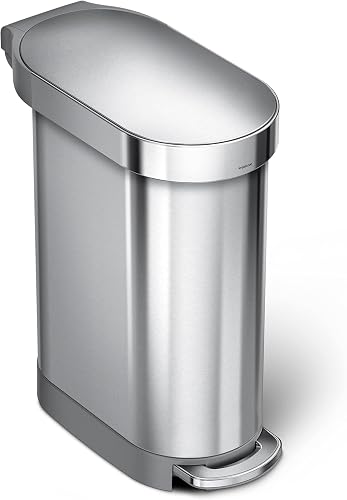
The simplehuman 45 L Slim Hands-Free Can is our top pick for a slim kitchen trash can because its liner rim secures the bag without an inner bucket. Choose it for a narrow wall or cabinet gap with enough floor depth.
The iTouchless is a better match if you want standard 13-gallon bags and an included odor filter. The EKO X-Wing suits spaces where a single lid would rise too high.
A slim can solves a width problem, but it can create a depth or access problem. The right choice leaves room for walking, opening nearby drawers and pulling out a full bag.
Start with your available space, then choose capacity around your disposal routine. Our kitchen trash can sizes guide explains how gallons and liters relate to everyday use.
Our picks at a glance
-
1
-
2

-
3

How we chose slim kitchen trash cans
We compared footprint, usable access, liner setup and lid design to find cans that solve different narrow-space problems. The order reflects each can's overall fit for this search, while the badges point to specific buying needs.
A bag-gripping rim matters if loose liners annoy you. A removable bucket matters more if you want to lift out the part that catches spills.
Every pick uses a foot pedal, so these are choices for people who want mechanical opening without batteries. Our best step trash cans guide covers more shapes if your space can accept a wider body.
Use the comparison table to rule out poor fits before weighing convenience features. A preferred finish or extra storage compartment won't make up for a blocked cabinet door.
| Product | Best for | Capacity | Size (L x W x H) | Opening | Our score |
|---|---|---|---|---|---|
| simplehuman 45 L Slim Hands-Free Can | narrow kitchen gaps | 45 L / 12 gal | 21.5 x 10.2 x 24.4 in | Step-on | 8.5 |
| iTouchless 13.2 Gal Slim Step Can | busy family kitchens | 13.2 gal / 50 L | 19.49 x 10.04 x 24.41 in | Step-on | 8.0 |
| EKO Hudson Slim Step Can | frequent meal prep | 13.2 gal / 50 L | 9.8 x 18.7 x 24.6 in | Step-on | 7.4 |
| EKO X-Wing Slim Step Can | low overhead spaces | 13.2 gal / 50 L | 19.7 x 10.7 x 24.8 in | Step-on, dual wing lid | 7.2 |
| Glad 12 Gal Slim Step Can | quick bag changes | 12 gal / 45 L | 19.43 x 9.8 x 24.3 in | Step-on | 7.0 |
The best slim kitchen trash cans by use
The simplehuman is the strongest overall choice, but the right alternative depends on your bags, overhead space and cleanup habits. Read each recommendation alongside its main reason to skip it.
simplehuman 45 L Slim Hands-Free Can: Best for narrow kitchen gaps
- 45 L capacity
- 21.5 x 10.2 x 24.4 in
- Bucket-free liner rim
- Lid Shox slow close
Choose this can for a narrow space with enough depth for its longer body. Its liner rim grips and hides the bag without an inner bucket.
Pros
- Liner rim secures and conceals the bag
- No inner bucket to lift during bag changes
- Controlled slow-close lid
Cons
- Longer footprint than the other picks
- No separate bucket to carry to a sink for cleaning
The simplehuman suits a kitchen where the can stays beside cabinets and neat liner changes matter more than having a removable bucket. Its stainless steel rim lifts for bag access, then closes over the liner to grip and conceal it.
That setup removes one step from changing a bag: you don't have to lift a bucket first. It also means a leaking liner leaves you cleaning inside the main body rather than carrying a separate insert to the sink.
Code N custom-fit liners are designed for this can. They give you a clear starting point for bag fit if you don't want to work around loose folds at the rim.
simplehuman says its steel pedal is engineered for 150,000 steps, and its Lid Shox mechanism controls the slow close. Those features suit frequent daily use, though they don't replace checking that your placement allows a full pedal stroke.
Skip it if floor depth is tight. Its longer body could project farther into a walkway than the other picks.
For more choices in this finish, see our best stainless steel kitchen trash cans.
iTouchless 13.2 Gal Slim Step Can: Best for busy family kitchens
- 13.2 gal capacity
- 19.49 x 10.04 x 24.41 in
- Includes activated carbon odor filter
- Fits standard 13-gallon bags
A useful choice for kitchens that need more capacity without a broad footprint. It accepts standard 13-gallon bags and includes an activated carbon odor filter.
Pros
- Works with standard 13-gallon bags
- Includes an odor filter
- Retainer rim keeps the bag edge hidden
Cons
- Plastic lid rather than an all-steel exterior
- Bucket-free interior requires cleaning inside the main body
The iTouchless suits households that want more capacity and familiar bags in a narrow body. It works with standard 13-gallon store-bought liners, so you can keep using that bag size without choosing a brand-specific code.
Its retainer rim secures the liner and hides the edge. The bucket-free design leaves no insert to lift, but spills beneath the bag need cleaning inside the can itself.
An included activated carbon filter adds an odor-control feature. Treat it as support for regular emptying, especially if raw food scraps or damp packaging make up much of your trash.
The plastic lid makes this a different finish choice from an all-steel can. Choose another pick if a stainless steel lid is part of the look you want.
The lid can remain open at 90 degrees, which helps during a longer cleanup. Rubberized base grips help limit movement, but the pedal still needs a level, clear floor area.
For alternatives beyond narrow step cans, start with our best kitchen trash cans roundup.
EKO Hudson Slim Step Can: Best for frequent meal prep
- 13.2 gal capacity
- 9.8 x 18.7 x 24.6 in (L x W x H)
- Lid frame stays open at 90 degrees
- Back carry handle
The Hudson suits repeated scrap disposal during cooking, with a lid frame that stays open at 90 degrees. Its back handle helps when moving the can to clean the floor.
Pros
- Stay-open frame for prep and liner changes
- Fingerprint-resistant stainless steel
- Includes Code J bag samples
Cons
- Dimension labels need an orientation check before fitting a gap
- Raised lid frame needs overhead room
The EKO Hudson suits cooks who want to leave the disposal area open during prep. Its lid frame stays at 90 degrees, so you can clear scraps repeatedly without pressing the pedal for each handful.
That feature is useful when peeling vegetables or clearing several plates. Close the frame when the task ends so food waste isn't left exposed between meals.
The back carry handle helps when moving the can to sweep behind it. Its fingerprint-resistant stainless steel finish also suits an exposed spot where people may brush against the body.
EKO includes Code J bag samples, giving you a starting liner to check before stocking up. EKO says the pedal is engineered for more than 200,000 open-and-close cycles.
Confirm its orientation before ordering for a tight gap. Its dimensions use 9.8 in for length and 18.7 in for width, so don't assume the shorter measurement is the side that faces outward.
Skip the Hudson if your space leaves no room for its raised frame. A stay-open feature only helps when the lid can reach that position freely.
EKO X-Wing Slim Step Can: Best for low overhead spaces

- 13.2 gal capacity
- 19.7 x 10.7 x 24.8 in
- Center-split dual wing lid
- Removable inner bucket
Choose the X-Wing when a tall single lid would hit an obstruction. Its split lid reduces overhead clearance needs, while the removable bucket helps contain spills.
Pros
- Lower opening height than the Glad
- Removable bucket with hidden handles
- Bag fixer secures the liner
Cons
- Wider body than the simplehuman, iTouchless and Glad
- Split lid still requires a clear opening path
The EKO X-Wing is the clearest choice here when overhead clearance limits placement. Its center-split lid rises less than a conventional single lid, with a full open height of 29.7 in.
The removable inner bucket is another reason to choose it. Hidden bucket handles let you lift the insert for cleanup, and a bag fixer helps hold the liner in place.
This arrangement suits people who prefer a separate container beneath the bag. It also adds a part to lift and clean, so choose a bucket-free model if you want fewer pieces during liner changes.
A stay-open lock supports longer cleanup tasks, while non-slip base pads help keep the can steady. EKO says the steel pedal is engineered for more than 200,000 steps.
Skip it if width is your strictest limit. Its body is wider than the simplehuman, iTouchless and Glad, even though its lid needs less room above.
Check the opening path against counter edges as well as the height above the can. A split lid still needs space for both wings to move.
Glad 12 Gal Slim Step Can: Best for quick bag changes

- 12 gal capacity
- 19.43 x 9.8 x 24.3 in
- Stay-open lid
- Rear bag storage compartment
The Glad keeps replacement bags close with rear roll storage, while bag rings hold the liner in place. It suits a narrow spot with generous room above the lid.
Pros
- Rear compartment stores a bag roll
- Bag rings secure loose liner edges
- Stainless steel body and lid
Cons
- Less capacity than the 50 L options
- Tall full-open lid needs substantial overhead room
The Glad suits people who want replacement bags stored at the can. Its rear roll compartment keeps the next liner close, while bag rings secure the bag and tuck away loose material.
That combination helps make bag replacement a single task rather than a trip to another cupboard. Leave enough access behind the can to refill the compartment without fighting a tight wall gap.
The body and lid are stainless steel with a fingerprint-resistant finish. Glad says its Clorox Protection helps block unwanted odors, but food waste still needs timely removal.
Its stay-open option helps during cooking and cleanup. The soft-close lid then lowers in a controlled motion when you're finished.
Skip it beneath a low shelf or counter. The lid needs 40.2 in of total height when fully open, which is a much larger vertical space than the closed body suggests.
Choose this can when narrow width and nearby bag storage solve your daily problems. Choose a larger-capacity pick if your current kitchen bag fills too quickly.
What should you measure before buying a slim can?
Measure the whole working space, including the footprint, lid path, pedal area and room to remove a bag. Closed dimensions alone won't tell you whether the can will work in that spot.
Start at floor level, where baseboards or cabinet trim can narrow the gap. Measure again higher up if a counter lip or handle projects into the space.
Check the slim kitchen trash can footprint
Mark the can's floor dimensions with painter's tape before ordering. Include the full depth rather than judging fit from the narrow side alone.
Walk past the taped area while carrying a tray or laundry basket. A can that leaves you turning sideways several times a day is using space you still need.
Open the nearest cabinet door, drawer, dishwasher and oven where relevant. Check their full movement rather than stopping once they clear the tape.
Don't plan to wedge the can tightly between hard surfaces. You need enough clearance to position it and move it out without scraping the finish.
Leave room for your foot and the full bag
Stand where you would normally use the pedal and check that your foot has a clear approach. A pedal behind a cabinet corner can make an otherwise suitable can awkward to open.
Next, picture lifting a filled liner straight up. A shelf can leave enough room for daily disposal while blocking bag removal.
If you'll pull the can forward for each bag change, keep that route clear. Avoid a setup that requires moving a stool or another bin every time.
Measure lid travel separately
Measure upward from the floor to the lowest obstruction above the can. Compare that space with the full opening height, not just the closed height.
Where the opening height isn't supplied, confirm it before choosing an overhead-restricted spot. Don't assume a lid can operate partly open without affecting access.
If you're unsure which volume fits your routine, our kitchen trash can size guide explains how household habits affect the choice.
How much capacity does a narrow kitchen can need?
Choose capacity around your waste stream, rather than household size alone. A kitchen that separates recycling and food scraps may need less trash space than one that puts most waste into a single bag.
The choices here fall into 45 L and 50 L groups. That difference can matter near the end of a busy day, but neither size makes sense if waste sits too long before removal.
Look at what fills your current can first. If bulky dry packaging takes most of the space, flatten suitable items and separate recyclables before buying a bigger bin.
If damp food waste causes odor while the bag is still mostly empty, extra capacity won't solve the problem. A smaller load removed sooner is often the better routine.
Also consider the weight you can comfortably lift. A tall narrow bag packed tightly with wet waste can be harder to remove than its volume suggests.
Keep broken glass and sharp packaging from pressing directly against the liner. Follow local disposal guidance for sharp items rather than relying on a thicker bag alone.
Is a slim step can better than a sensor can?
A step can is the better fit if you want foot-operated opening without batteries. All 5 picks let you keep your hands away from the lid during routine disposal.
Think about how you approach the can while cooking. A clear pedal at the front works well when both hands are holding scraps or a cutting board.
A sensor can may suit you better if reaching a floor pedal is difficult. Its placement needs to suit the sensor's operating area, while a step model needs space for your foot.
Compare the daily tradeoffs in our touchless vs step trash can guide. Choose the opening method before narrowing your decision to finishes or bag storage.
How do liner systems differ on slim cans?
Choose a liner system that matches how you change bags and clean spills. Bag retention and removable buckets solve different problems, so don't treat either one as a substitute for the other.
A rim or bag ring holds the liner near the opening. A removable bucket provides a separate surface beneath it that you can lift out when it needs cleaning.
Choose bucket-free access or a removable insert
The simplehuman and iTouchless use bucket-free interiors. Those suit people who want to open the rim, remove the bag and fit a replacement without handling an insert.
The X-Wing has a removable bucket. Choose that approach if carrying the interior container to a cleaning area matters more than keeping the number of parts low.
Neither system prevents every leak. Check beneath the liner during changes, especially after disposing of wet packaging.
Check bag shape as well as gallon size
A gallon label doesn't describe a bag's exact shape. A liner can have enough volume yet be too short to reach the bottom or too loose around a narrow opening.
Fit a fresh bag down into the base before securing the top. That lets the bottom support the load instead of leaving waste hanging from the rim.
Smooth out excess folds where the lid closes. Keep ties and loose edges away from the hinge and pedal mechanism.
Use a small pack or included samples to confirm fit before buying a large supply. Save the liner code or bag dimensions once you find a setup that works.
Where should a slim trash can go in the kitchen?
Place the can near routine waste disposal without blocking movement. A slightly wider open spot can work better than a narrow gap that leaves the pedal hard to reach.
Beside the prep area is useful if you generate scraps while cooking. Near the cleanup area may work better if most waste comes from clearing plates and unpacking food.
Check the route between the sink, stove and refrigerator. The can shouldn't force a detour through the part of the kitchen you cross most often.
Rear features need access too. A carry handle or bag compartment becomes less useful if the can must be dragged out from a tight slot whenever you need it.
For layout examples and placement tradeoffs, see where to put a trash can in the kitchen.
How should you set up a new slim step can?
Set the can on a clean, dry, level floor, then fit a liner and check the lid before adding waste. A few careful adjustments can prevent bag slips and awkward pedal use.
- Remove packaging from the body, lid and pedal area.
- Follow the supplied instructions for any filter, damper or other included parts.
- Seat the bag fully at the bottom and secure it with the intended rim, rings or fixer.
- Press and release the pedal with the can empty.
- Check that the lid opens freely and closes without catching the bag.
- Move nearby doors and drawers through their full range.
Use the stay-open feature only as directed for the model. Don't force a lid or frame backward to make it stay raised.
After the first bag change, check whether the liner slipped or collected in thick folds. Adjust the bag fit before adding another full load.
How do you keep a narrow kitchen trash can clean?
Remove wet waste promptly and clean spills when you find them. A filter, odor treatment or tight-closing lid supports that routine but doesn't replace it.
Wipe drips from the rim before they dry. Pay attention to liner grips, lid edges and the area beneath bag folds, where small scraps can collect.
For routine cleaning, follow the can's care instructions and use a soft cloth with a mild cleaner where allowed. Avoid abrasive pads that can scratch the finish.
Dry the interior before fitting a new liner. Trapped moisture can leave the next bag sitting against a damp surface.
Keep cleaning liquid away from hinges and the pedal mechanism, and don't soak the whole can. A removable bucket can be cleaned separately according to its care instructions.
Fingerprint resistance reduces visible marks rather than eliminating cleaning. Our stainless steel trash can cleaning guide covers care for the exterior.
Which mistakes make a slim can harder to use?
The most common mistake is buying for width alone. Depth, lid travel and bag-removal access decide whether that narrow body will actually help your kitchen.
Avoid these other problems:
- Packing trash past the rim: waste can obstruct the lid and make the bag harder to pull free.
- Choosing capacity to delay emptying: wet food waste may need removal before the bag is full.
- Letting a liner hang above the base: the load can pull against the bag's grip at the rim.
- Using a stay-open lid for all-day storage: close it once the disposal task ends.
- Forcing an obstruction: if the lid catches, check placement and bag folds before pressing harder.
- Buying bags in bulk too soon: confirm length and rim fit with a smaller supply first.
Recheck placement if the can shifts during use. Start with the floor surface, pedal access and nearby obstructions rather than pushing the body tightly against cabinetry.
Which slim kitchen trash can should you choose?
Choose your slim kitchen trash can by its hardest fit requirement first. Once a model clears the footprint, lid path and bag-removal checks, use the liner system to break the tie.
Pick the simplehuman if you want a concealed bag rim without a removable bucket and have room for its longer footprint. It is the most direct choice for a narrow gap where liner access matters.
Pick the iTouchless if standard 13-gallon bags and an included odor filter best match your routine. Choose the Hudson if frequent food prep makes a raised lid frame useful and its orientation fits your space.
Pick the X-Wing when overhead clearance rules out a conventional lid, especially if you want a removable bucket. Choose the Glad when nearby bag storage matters and the lid has generous room to rise.
Before ordering, mark the footprint and practice the bag-removal motion in that spot. Then use our kitchen trash can sizes guide to confirm that the capacity matches what you actually throw away.
Our top 3 picks at a glance
-
1
-
2
-
3
Frequently asked questions
How narrow should a slim kitchen trash can be?
Choose a can narrower than your gap, leaving room to move it without scraping the sides. Measure the narrowest point, including baseboards and cabinet trim, then check depth, pedal access and lid movement.
A narrow body still needs enough working space for you to remove a full bag.
Are slim kitchen trash cans smaller inside?
Slim kitchen trash cans can hold a full kitchen load: these picks offer 45 L or 50 L capacities. Their narrow shape uses depth to preserve volume.
Choose capacity around how quickly your household fills a bag, and empty food waste before odor becomes a problem rather than waiting for the can to fill.
Do slim step cans need special trash bags?
Some slim step cans accept standard bags, including the iTouchless, which works with standard 13-gallon liners. simplehuman offers Code N liners for its slim can, while the Hudson and X-Wing have Code J and Code F options. Check bag length and rim fit before buying a large supply.
Which slim kitchen trash can works under a counter?
The EKO X-Wing is the strongest candidate here for limited overhead space, with a full open-lid height of 29.7 in. Measure beneath the lowest obstruction, then check the entire lid path and pedal access.
You also need room to lift out the liner or move the can forward.


