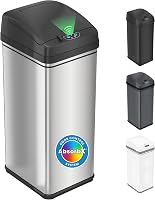
EKO Mirage-T 13.2 Gallon Sensor Trash Can Review: Worth It? (October 2026)
The EKO Mirage-T 50 liter suits kitchens that need touchless access beside a wall or cabinet. Choose it for its standard bag fit and stay-open control, provided you have overhead clearance and don't need a removable inner bucket.
On this page (9 sections)
- Is the EKO Mirage-T 50 liter right for your kitchen?
- What features matter most on the Mirage-T?
- How do you check whether it will fit?
- Is this the right capacity for your household?
- What does the no-liner design mean for bag changes?
- How should you set up the sensor and power?
- Which alternative should you choose instead?
- How do you keep the finish and interior clean?
- Should you buy the EKO Mirage-T 50 liter?
The EKO Mirage-T 50 liter is a good choice for touchless kitchen disposal beside a wall or cabinet, especially if you want to use ordinary kitchen bags. Its main trade-offs are battery upkeep, overhead lid clearance and an interior without a removable bucket.
Choose it for food prep and daily cleanup when reaching for a lid is inconvenient. Skip it if you want a pedal-operated can, a manual pet lock or a bucket you can carry out for washing.
Is the EKO Mirage-T 50 liter right for your kitchen?
The Mirage-T suits a kitchen where easy access and a wall-side position matter more than a lock or separate inner bucket. Its stay-open switch also helps when you're adding waste repeatedly during one cleanup job.
EKO Mirage-T 13 Gal Sensor Can: Best for wall-side kitchens

- 50 liters / 13.2 gallons
- Motion sensor lid
- No-liner design
- AA alkaline batteries
Choose this rectangular can for touchless disposal beside a wall or cabinet. A removable bag rim and stay-open touch switch help with bag changes and longer cleanup jobs.
Pros
- Fits standard 13 gallon kitchen bags
- Removable rim holds and hides the bag edge
- Stay-open control for longer cleanup jobs
- Fingerprint-resistant finish and quiet-close lid
Cons
- Requires AA alkaline batteries, not included
- Needs 36 in of height with the lid open
- No separate inner bucket for carrying out leaks
Who should choose the EKO Mirage-T 50 liter?
Choose it if you regularly scrape plates, peel vegetables or handle packaging with messy hands. The sensor lets you open the lid without reaching for a handle, while the quiet-close feature lowers it gently afterward.
The rectangular body makes sense along a cabinet run, provided it doesn't block a drawer or narrow the route through the kitchen. The brushed finish also suits a visible spot near stainless steel appliances.
Skip it if battery replacement would become a neglected chore. A step can is a better match when you want hands-free opening through a simple foot action; our touchless vs step trash can guide explains that choice.
A household with a determined bin-raiding pet should prioritize a suitable locking design. Touchless opening alone doesn't give you control over who or what can trigger access.
What features matter most on the Mirage-T?
The most useful features are standard bag compatibility, the bag-holding rim and stay-open control. These affect everyday use more than the stainless finish does.
| Detail | EKO Mirage-T |
|---|---|
| Capacity | 50 liters / 13.2 gallons |
| Shape | Rectangular |
| Finish | Fingerprint-resistant brushed stainless steel |
| Opening | Motion sensor with quiet close |
| Longer access | Stay-open touch switch |
| Bag fit | Standard 13 gallon kitchen bags |
| Interior | No separate inner bucket; removable bag-holding rim |
| Power | AA alkaline batteries, not included |
| Dimensions | 15.1 W x 10.2 D x 24.6 H in |
| Alternate footprint measurement | 14.8 x 9.8 in |
| Height with lid open | 36 in |
The rim secures the bag and tucks its edge out of sight. That matters if the can stands in an open kitchen where a loose bag cuff would be visible.
Use the stay-open control for a run of small tasks, such as trimming produce, rather than repeatedly moving scraps toward the sensor. Close the lid after the task so food waste isn't left exposed.
How do you check whether it will fit?
Measure floor space, open-lid clearance and room to remove a full bag before choosing a spot. A can that fits while closed can still be awkward beneath a counter.
Use the larger dimensions above when marking out the footprint with tape. EKO provides two footprint measurements, so confirm the exact size before ordering if the gap between your cabinets is tight.
The lid reaches 36 inches high when open. Leave space above that point so it can move freely, and check the full opening path rather than measuring only the height of a nearby shelf.
Next, open nearby drawers, cabinet doors and the dishwasher. Stand where you'll normally scrape a plate, then check whether another person can pass without bumping the can.
Bag removal needs room too. If you must pull the can out from under an overhang every time you empty it, a more open location will make the daily routine easier.
For help choosing between a prep-area spot and a cleanup-area spot, see where to put a trash can in a kitchen.
Is this the right capacity for your household?
Choose capacity by how quickly waste builds up and what goes into the bag, rather than household size alone. A smaller household that cooks often can produce more kitchen waste than a larger one that eats elsewhere.
Compare your current bag at the point when you normally remove it. If it's full of light packaging, extra volume may help; if you empty it because food scraps smell, a larger can won't solve that problem.
Separate recyclable packaging before deciding that you need a bigger trash can. Flatten suitable boxes outside the bin rather than forcing bulky pieces through the opening or packing them tightly inside.
Dense waste creates another limit: lifting weight. Don't wait for the bag to reach the top if wet scraps already make it difficult to carry.
Our kitchen trash can size guide explains capacity labels and helps you compare this model with your current bin.
What does the no-liner design mean for bag changes?
Here, “no liner” means no separate inner bucket, not that you should use the can without a trash bag. Waste goes into a bag supported inside the can's body.
EKO says this design provides 25% more capacity by removing the inner bucket. That describes its use of interior space; it doesn't add another quarter to the stated volume.
For a fresh bag, spread it fully inside the body before securing its mouth around the removable rim. Leave enough slack for the bag to reach downward instead of hanging tightly from the top.
Check the edge all the way around before replacing the lid. A bunched cuff can interfere with the fit, while a poorly secured edge can slip inward as waste accumulates.
Don't push sharp packaging against the bag or compress waste with your hands. Stop filling before rubbish crowds the lid, and loosen any snagged material gently when removing the bag.
The main drawback appears after a leak. You need to clean the can's interior where it stands or move the body to a suitable cleaning area, rather than lifting out a smaller bucket.
How should you set up the sensor and power?
Start with the right batteries, a correctly fitted bag and a clear sensor area. Check normal opening and closing before filling the can.
The Mirage-T uses AA alkaline batteries, and EKO advises against rechargeables. Install them according to the compartment markings and follow EKO's instructions for the controls.
EKO claims battery life of up to 8 months. Treat that as an upper estimate rather than a replacement schedule, and keep a spare set where you can find it.
Position the can where normal kitchen traffic won't repeatedly pass close to the sensor. A spot that looks tidy beside a busy doorway may cause more unwanted opening than a quieter place along a cabinet.
Keep hanging towels, loose bag edges and nearby objects away from the sensor and lid path. If the lid behaves oddly, check those obstructions and the battery supply before assuming the mechanism has failed.
Our iTouchless battery replacement guide covers general battery-change habits for another brand. Follow EKO's instructions for the Mirage-T's battery requirements and compartment layout.
Which alternative should you choose instead?
Choose an alternative only when it addresses a specific need the Mirage-T doesn't meet. The strongest reasons here are a manual lock, substantially more capacity or a different finish.
iTouchless: choose it for controlled lid access
The iTouchless adds a manual Pet Lock and an included AbsorbX carbon odor filter. It suits households that want to disable lid opening when pets or young children are near the can.
Engaging the lock stops the lid from opening, so you'll need to disengage it when you want normal access. That makes it useful for planned control, rather than an automatic way to distinguish a person's hand from a pet.
Its body measures 12.7 x 10.8 x 27.3 inches. Check its orientation in your intended spot, since the taller shape may change how it fits beside cabinets.
Skip this alternative if you won't use the lock or maintain an odor filter. Read the iTouchless 13 gallon sensor can review for a closer look at those features.
EKO Mirage X: choose it for bulky daily waste
The Mirage X suits busy kitchens that fill smaller cans with light, bulky rubbish. Its 80 liter capacity gives those households a meaningful increase in space.
The body measures 18.5 x 11 x 27.1 inches, so mark out its footprint separately. It also has a press-to-open option that keeps the lid open for 20 minutes.
Choose it for extended cleanup sessions or shared kitchens where packaging quickly fills the bag. Make sure everyone who empties it can comfortably manage the larger load.
Skip it if your main waste is wet food scraps or you struggle to lift full bags. Extra capacity can encourage leaving waste indoors longer when earlier removal would be more useful.
EKO Matte Stainless: choose it for the finish
The matte EKO suits buyers who want a less reflective-looking stainless finish in a visible kitchen spot. It offers sensor opening and a no-liner interior in the same capacity class as the Mirage-T.
Its body measures 15.5 x 10.6 x 24.6 inches. Don't assume it will fit a gap measured for the brushed model just because the capacity is the same.
Choose it when the finish works better with your cabinets and appliances. Skip it if you already prefer brushed steel, since the matte finish doesn't solve a need for a lock, larger volume or removable bucket.
For choices beyond these sensor models, browse our best kitchen trash cans guide.
How do you keep the finish and interior clean?
Use gentle wiping outside and prompt spill cleanup inside. Fingerprint resistance reduces visible marks, but food residue and grease still need attention.
Wipe the exterior with a soft cloth and a mild cleaner allowed by EKO's care instructions. Avoid abrasive pads, then dry the surface to reduce water marks.
Give the rim and lid edges regular attention because they sit close to waste and get handled during bag changes. Remove stuck scraps before they affect bag fit or lid movement.
Keep liquid away from the sensor, controls and battery compartment. Apply cleaner to a cloth rather than spraying directly toward the lid electronics, and don't immerse the powered lid.
After a bag leaks, remove the waste, clean the affected interior and let it dry before fitting a fresh bag. Our guide to cleaning a stainless steel trash can covers the process in more detail.
For persistent odors, shorten the time food waste stays indoors and clean residue beneath the rim. See how to keep a kitchen trash can from smelling for more odor-control habits.
Should you buy the EKO Mirage-T 50 liter?
Buy the EKO Mirage-T 50 liter if your measured space fits, ordinary kitchen bags suit your routine and sensor access makes cleanup easier. Its strongest use is a wall-side kitchen spot with clear space above.
Choose iTouchless if controlling lid access is the deciding factor. Move to the Mirage X if bulky waste fills your current can too quickly, or choose the matte EKO when its finish better suits the room.
If none of those needs settles the choice, decide how you want to open the lid every day. Our best touchless trash cans guide is the next step for comparing sensor options.
Frequently asked questions
Is the EKO Mirage-T 50 liter really 13.2 gallons?
Yes. Its 50 liter capacity equals about 13.2 US gallons, often rounded to 13 gallons.
It accepts standard 13 gallon kitchen trash bags, held by a removable inner rim.
Secure the bag around that rim and leave enough material inside so waste doesn't pull the edge loose.
Does the EKO Mirage-T need batteries?
Yes. The Mirage-T requires AA alkaline batteries, which aren't included, and EKO advises against rechargeable batteries.
EKO claims up to 8 months of use, but replacement timing depends on use.
Follow the battery markings during installation, and check the power supply first if the sensor becomes unresponsive.
Can the EKO Mirage-T lid stay open?
Yes. A touch switch holds the lid open for longer cleanup jobs, such as peeling vegetables or clearing several plates.
Return it to normal operation when you're finished so waste stays covered.
The open lid reaches 36 inches high, so leave enough space above the can.
Does the EKO Mirage-T have an inner bucket?
No. The Mirage-T holds a trash bag inside the body without a separate inner bucket, using a removable rim to secure the bag.
That means a leak needs cleaning inside the can itself.
Choose a different design if carrying a removable bucket to a sink is a priority.