Recycle Bin vs Trash Can: Do You Need Both? (October 2026)
You need both only if separating recycling makes sorting easier for your household. A dual compartment can combines the jobs, while separate bins give you more control over size and placement.
On this page (14 sections)
- Recycle Bin vs Trash Can: Do You Need Both?
- Recycle bin vs trash bin: do you need both?
- When does one dual compartment can make sense?
- When are two separate bins better?
- How much room do the bins need?
- What belongs in each container?
- Which setup should you choose?
- Recycle Bin vs Trash Can: Do You Need Both?
- Recycle bin vs trash bin: do you need both?
- When does one dual compartment can make sense?
- When are two separate bins better?
- How much room do the bins need?
- What belongs in each container?
- Which setup should you choose?
Recycle Bin vs Trash Can: Do You Need Both?
You need a recycle bin and a trash can when your household sorts waste, but they don't have to be separate containers. A dual compartment can holds both streams together; standalone bins let you choose each size and place them where they fit.
The right setup depends on local recycling rules, how much of each type of waste you produce and the space available in your kitchen. If you rarely recycle at home, a single trash can may be enough.


Recycle bin vs trash bin: do you need both?
Use separate containers for trash and recycling when local rules call for sorting, then decide whether one divided can or two bins suits your routine. The key difference is how you want to store each stream.
A dedicated recycle bin helps keep accepted items apart from general trash. A standalone trash can gives you a separate place for food scraps and other waste your recycling program does not accept.
A dual compartment model puts both sections in one outer body. It can save you from placing two full-size cans side by side, but its sections have fixed capacities.
Your local recycling program sets what belongs in each stream. Check its rules before settling on a container setup, especially if you recycle glass, food containers or paper that needs to stay dry.
When does one dual compartment can make sense?
Choose a dual can if you sort waste in the kitchen and want both openings within one footprint. Separate pedals or lids can let you access one side without opening the other.
That arrangement may help when you have a clear spot for one larger can but not two separate bins. It also gives each stream a defined section, which can make sorting easier during meal prep and cleanup.
The tradeoff is fixed capacity. If your recycling fills much faster than your trash, an equal split can leave one side full while the other has room.
Which split fits your trash and recycling?
The EKO EcoCasa 30 L + 20 L Dual Can gives you a larger trash section and a smaller recycling section if those proportions match your household. Its two pedals and lids operate independently, and the inner buckets are removable.
The Simpli-Magic 60 L Hands-Free Dual Can divides its capacity into two 30 L sections. That equal split may suit households whose trash and recycling build up at similar rates.
For more layouts and sizes, compare the options in our best dual compartment trash and recycling cans guide. Measure the spot as well as the can, since a divided model still needs room for its full outer body and lid.
When are two separate bins better?
Choose two separate bins when each waste stream needs a different size, location or emptying routine. You can keep a small trash can near food preparation and a larger recycling container in a pantry or utility area.
Separate containers also make it easier to expand one stream without replacing the other. If you collect a lot of bottles or cardboard, a larger recycling bin may be more useful than a can with two fixed sections.
The drawback is floor space. Two bins need two accessible spots, and their placement should still make sorting easy.
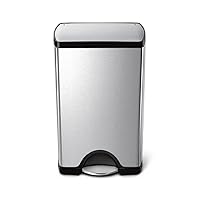
Consider a standalone trash can if recycling already has another home. The simplehuman 45 L Rectangular Step Can offers a single trash compartment, with a liner rim that holds the bag and a pocket for storing liners.
Our best kitchen trash cans guide compares single and divided styles for different kitchen routines.
How much room do the bins need?
Measure the usable spot and the space needed to open each lid before choosing between one divided can and two bins. A can that fits with the lid closed may still block a cabinet, drawer or walkway when opened.
For a dual can, check its full outer width and depth, plus the lid's open height if it sits under an overhang. For separate bins, measure the space for both containers and leave enough access to remove each one.
Think about where you stand while sorting. A recycling bin across the kitchen may be harder to use than a compact section next to the trash, even if the distant bin holds more.
Use our kitchen trash can size guide to compare capacity and dimensions. If you're still choosing an overall layout, how to choose a kitchen trash can covers placement, lid style and odor control.
What belongs in each container?
Put only materials accepted by your local recycling program in the recycle bin. Rules vary by location, so check the local guidance rather than assuming a package is recyclable everywhere.
Keep trash separate from accepted recyclables to avoid sorting mistakes. Some programs require items to be empty or prepared in a certain way; follow the instructions for your collection service.
A divided can helps keep the streams apart at home, but it doesn't change what your local program accepts. If a material is not accepted, use the disposal option your local guidance recommends.
Which setup should you choose?
Pick one dual can if a shared footprint and easy kitchen sorting suit your household; pick two bins if the streams need different sizes or locations. Choose a single trash can when recycling already has a separate place.
For an unequal load, consider the EKO EcoCasa 30 L + 20 L Dual Can. For similar amounts on both sides, the Simpli-Magic 60 L Hands-Free Dual Can offers two equal 30 L compartments.
If you want one trash compartment and separate recycling, the simplehuman 45 L Rectangular Step Can fits that arrangement. Measure the space and check local rules before you choose.
title: Recycle Bin vs Trash Can: Do You Need Both? type: versus category: step-and-dual keyword: recycle bin vs trash bin topic: recycle bin vs trash can description: "Recycle bin vs trash bin: compare separate bins with a dual compartment can, then choose a setup that fits your recycling habits, kitchen space and daily routine." publish: 2026-10-21T12:45:00-04:00 writer: gpt-6-luna answer: "You need both only if separating recycling makes sorting easier for your household. A dual compartment can combines the jobs, while separate bins give you more control over size and placement." related: [best-dual-trash-can-for-kitchen, best-kitchen-trash-can, kitchen-trash-can-sizes, choose-the-best-trash-can] products:
- asin: B09B36HVVQ
name: "EKO EcoCasa 30 L + 20 L Dual Can"
badge: "Best for unequal waste loads"
score: 7.6
features: ["30 L + 20 L compartments", "Independent pedals and lids", "Removable inner buckets", "Fingerprint-resistant stainless steel"]
specs:
- { label: Capacity, value: "50 L total, split 30 L + 20 L" }
- { label: Opening, value: "Two step pedals" }
- { label: Inner bins, value: "Two removable buckets" } summary: "Choose this divided can when your household needs a larger trash section and a smaller recycling section in one footprint. Separate pedals and lids let you open only the side you need." pros: ["Unequal 30 L and 20 L sections", "Independent pedals and lids", "Removable buckets have carry handles"] cons: ["The smaller side may fill quickly in recycling-heavy homes", "One cabinet footprint has to fit both waste streams"]
- asin: B00TXXPJBU
name: "simplehuman 45 L Rectangular Step Can"
badge: "Best for trash-only kitchens"
score: 8.8
features: ["45 L capacity", "Wide steel pedal", "Liner rim holds bag", "Built-in liner pocket"]
specs:
- { label: Capacity, value: "45 L" }
- { label: Opening, value: "Step-on lid" }
- { label: Material, value: "Brushed stainless steel" } summary: "This single compartment can suits a kitchen that already has a separate recycling container. Its liner rim grips and hides the bag, and its built-in pocket stores liners inside the can." pros: ["Single large compartment for trash", "Liner rim holds the bag in place", "Built-in pocket dispenses liners"] cons: ["No separate recycling compartment", "A second container needs its own floor or cabinet space"]
- asin: B0BTMY6JR7
name: "Simpli-Magic 60 L Hands-Free Dual Can"
badge: "Best for equal waste loads"
score: 7.2
features: ["Two 30 L compartments", "Color-coded liners", "Slow-close lid", "Built-in odor filter"]
specs:
- { label: Capacity, value: "60 L total, split 30 L + 30 L" }
- { label: Opening, value: "Hands-free foot pedal" }
- { label: Compartments, value: "Two color-coded liners" } summary: "Choose this larger dual can if trash and recycling build up at similar rates. Its equal 30 L sections provide the same listed capacity for each stream." pros: ["60 L combined capacity", "Equal 30 L compartments", "Color-coded liners help separate waste"] cons: ["Equal sections may not match uneven household waste", "The larger footprint needs a suitable spot"] faq:
- q: "Do you need a recycle bin and a trash can?" a: "You need separate places for recycling and trash if your local collection rules require sorting. They can be two standalone bins or a dual compartment can. Check your local recycling guidance first, then choose containers that fit the materials you recycle and the space you have."
- q: "Can one dual trash can replace two bins?" a: "A dual compartment can can replace two separate bins when its sections hold enough for your household and the materials you sort. Compare each compartment's capacity with how quickly trash and recycling accumulate. If one stream is much larger, unequal sections or separate bins may work better."
- q: "What size dual can should I choose?" a: "Choose capacity based on your household's waste and recycling habits, not the combined number alone. An equal split works when both sides fill at similar rates; a divided 30 L and 20 L can suits a larger trash load. Measure the placement area before choosing either style."
- q: "Should recycling go in a kitchen bin?" a: "A kitchen bin is convenient for clean packaging and other accepted recyclables you create while cooking. Follow your local collection rules, since accepted materials and preparation steps vary. If sorting makes the kitchen crowded, keep a larger recycling container in a pantry, utility area or garage."
Recycle Bin vs Trash Can: Do You Need Both?
You need a recycle bin and a trash can when your household sorts waste, but they don't have to be separate containers. A dual compartment can holds both streams together; standalone bins let you choose each size and place them where they fit.
The right setup depends on local recycling rules, how much of each type of waste you produce and the space available in your kitchen. If you rarely recycle at home, a single trash can may be enough.
Recycle bin vs trash bin: do you need both?
Use separate containers for trash and recycling when local rules call for sorting, then decide whether one divided can or two bins suits your routine. The key difference is how you want to store each stream.
A dedicated recycle bin helps keep accepted items apart from general trash. A standalone trash can gives you a separate place for food scraps and other waste your recycling program does not accept.
A dual compartment model puts both sections in one outer body. It can save you from placing two full-size cans side by side, but its sections have fixed capacities.
Your local recycling program sets what belongs in each stream. Check its rules before settling on a container setup, especially if you recycle glass, food containers or paper that needs to stay dry.
When does one dual compartment can make sense?
Choose a dual can if you sort waste in the kitchen and want both openings within one footprint. Separate pedals or lids can let you access one side without opening the other.
That arrangement may help when you have a clear spot for one larger can but not two separate bins. It also gives each stream a defined section, which can make sorting easier during meal prep and cleanup.
The tradeoff is fixed capacity. If your recycling fills much faster than your trash, an equal split can leave one side full while the other has room.
Which split fits your trash and recycling?
The EKO EcoCasa 30 L + 20 L Dual Can gives you a larger trash section and a smaller recycling section if those proportions match your household. Its two pedals and lids operate independently, and the inner buckets are removable.
The Simpli-Magic 60 L Hands-Free Dual Can divides its capacity into two 30 L sections. That equal split may suit households whose trash and recycling build up at similar rates.
For more layouts and sizes, compare the options in our best dual compartment trash and recycling cans guide. Measure the spot as well as the can, since a divided model still needs room for its full outer body and lid.
When are two separate bins better?
Choose two separate bins when each waste stream needs a different size, location or emptying routine. You can keep a small trash can near food preparation and a larger recycling container in a pantry or utility area.
Separate containers also make it easier to expand one stream without replacing the other. If you collect a lot of bottles or cardboard, a larger recycling bin may be more useful than a can with two fixed sections.
The drawback is floor space. Two bins need two accessible spots, and their placement should still make sorting easy.
Consider a standalone trash can if recycling already has another home. The simplehuman 45 L Rectangular Step Can offers a single trash compartment, with a liner rim that holds the bag and a pocket for storing liners.
Our best kitchen trash cans guide compares single and divided styles for different kitchen routines.
How much room do the bins need?
Measure the usable spot and the space needed to open each lid before choosing between one divided can and two bins. A can that fits with the lid closed may still block a cabinet, drawer or walkway when opened.
For a dual can, check its full outer width and depth, plus the lid's open height if it sits under an overhang. For separate bins, measure the space for both containers and leave enough access to remove each one.
Think about where you stand while sorting. A recycling bin across the kitchen may be harder to use than a compact section next to the trash, even if the distant bin holds more.
Use our kitchen trash can size guide to compare capacity and dimensions. If you're still choosing an overall layout, how to choose a kitchen trash can covers placement, lid style and odor control.
What belongs in each container?
Put only materials accepted by your local recycling program in the recycle bin. Rules vary by location, so check the local guidance rather than assuming a package is recyclable everywhere.
Keep trash separate from accepted recyclables to avoid sorting mistakes. Some programs require items to be empty or prepared in a certain way; follow the instructions for your collection service.
A divided can helps keep the streams apart at home, but it doesn't change what your local program accepts. If a material is not accepted, use the disposal option your local guidance recommends.
Which setup should you choose?
Pick one dual can if a shared footprint and easy kitchen sorting suit your household; pick two bins if the streams need different sizes or locations. Choose a single trash can when recycling already has a separate place.
For an unequal load, consider the EKO EcoCasa 30 L + 20 L Dual Can. For similar amounts on both sides, the Simpli-Magic 60 L Hands-Free Dual Can offers two equal 30 L compartments.
If you want one trash compartment and separate recycling, the simplehuman 45 L Rectangular Step Can fits that arrangement. Measure the space and check local rules before you choose.
Frequently asked questions
Do you need a recycle bin and a trash can?
You need separate places for recycling and trash if your local collection rules require sorting. They can be two standalone bins or a dual compartment can.
Check your local recycling guidance first, then choose containers that fit the materials you recycle and the space you have.
Can one dual trash can replace two bins?
A dual compartment can can replace two separate bins when its sections hold enough for your household and the materials you sort. Compare each compartment's capacity with how quickly trash and recycling accumulate.
If one stream is much larger, unequal sections or separate bins may work better.
What size dual can should I choose?
Choose capacity based on your household's waste and recycling habits, not the combined number alone. An equal split works when both sides fill at similar rates; a divided 30 L and 20 L can suits a larger trash load.
Measure the placement area before choosing either style.
Should recycling go in a kitchen bin?
A kitchen bin is convenient for clean packaging and other accepted recyclables you create while cooking. Follow your local collection rules, since accepted materials and preparation steps vary.
If sorting makes the kitchen crowded, keep a larger recycling container in a pantry, utility area or garage.